
A private urgent care centre for when you need immediate attention
 Read time: 3 mins
Article Summary
You should use a private urgent care centre if you need fast treatment for minor illnesses or injuries and want to avoid long A&E waits. Private urgent care offers same-day access, longer consultation time, experienced clinicians, and modern facilities for issues like fractures, cuts, burns, infections, and ENT problems. It is not for life-threatening emergencies.
There’s no need to wait around when you opt for a private urgent care centre.
When you suddenly become sick or injured and need urgent medical attention, the last thing you want is to have to spend long hours in a hospital waiting room before a doctor or nurse can treat you. But that’s the reality of the public health systems of many countries: too many patients, not enough medical staff and resources, including beds, stretching them to the limit.
That’s why more people are choosing a private urgent care centre when they have minor injuries and illnesses because they’ll be seen straight away with no waiting around. Clearly, if you have a serious injury like being involved in a road traffic accident and your life is at risk, you’ll be taken immediately to the accident and emergency department, possibly by ambulance.
A private urgent care centre is not like A&E because it most likely won’t be open around the clock, and they don’t usually treat life-threatening illnesses and injuries, including those to the head. Our private Urgent Care Clinic is located at the front of our hospital and is open from 8 am to 8 pm (last appointment at 7:30pm), Monday to Friday and 8am to 6pm (last appointment at 5:30pm) at the weekend.
When to visit an urgent care centre
It isn’t always obvious whether an injury or illness needs urgent attention or can wait for your GP. As a rule of thumb, a private urgent care centre is the right choice when you need to be seen the same day, but your condition isn’t life-threatening: things like a suspected sprain or fracture, a cut that won’t stop bleeding, a burn, or a sudden infection. Choosing a private urgent care clinic means you’re seen quickly, without the long waits often seen elsewhere, and with access to on-site X-ray and other diagnostic tests so you can be assessed and treated in the same visit rather than being sent elsewhere and having to wait for results. If you’re struggling to breathe, have chest pain, or think you or someone else is having a stroke, don’t wait, call 999 or go straight to your nearest A&E.
What does a private urgent care centre treat?
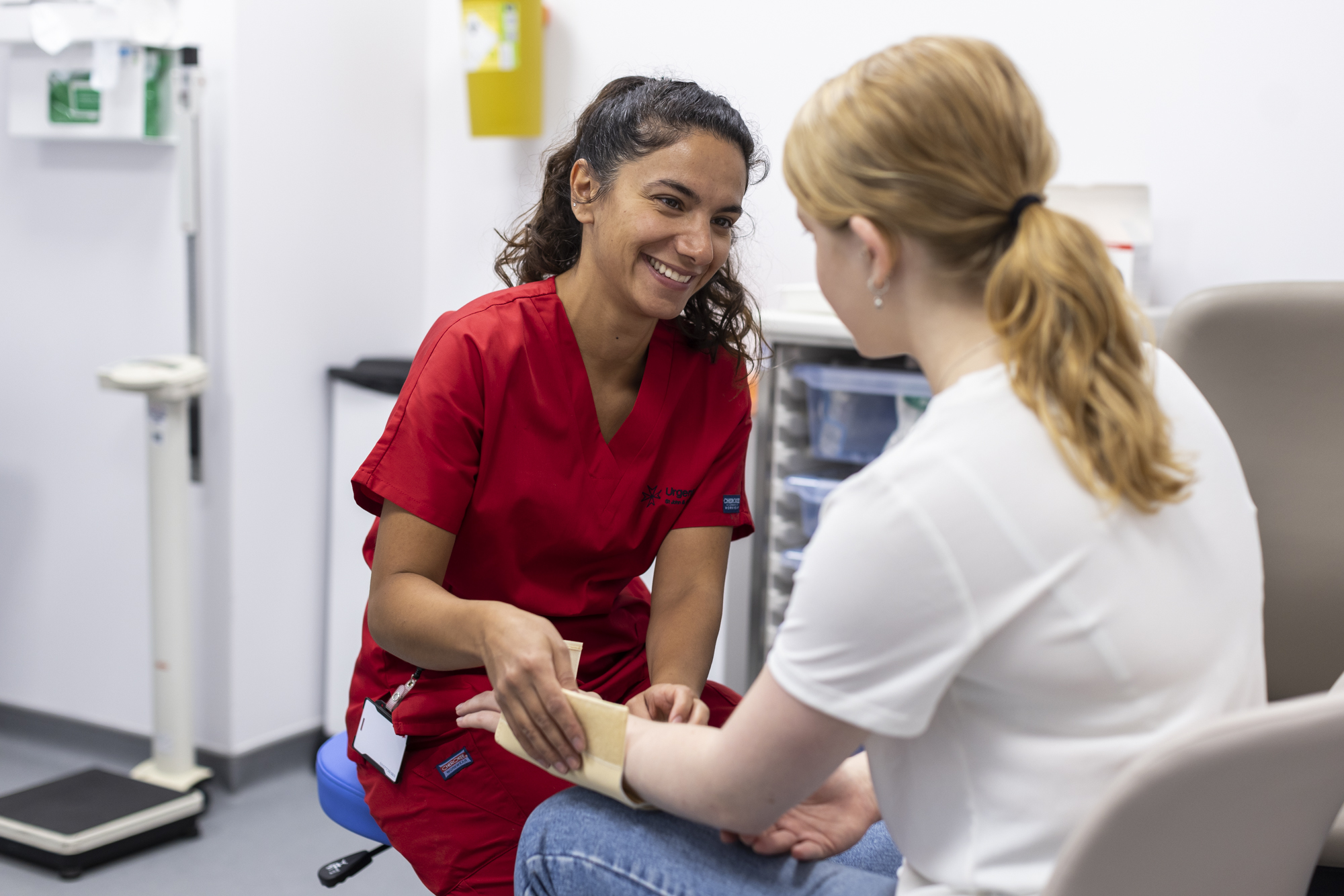
A private urgent care centre primarily deals with the walk-in wounded — people who have been injured in a minor accident or have suddenly taken ill but can still get to hospital themselves. Highly experienced nurses and doctors at private urgent care centres usually deal with common injuries arising from sports, such as fractures and sprains, and also cuts and grazes that need cleaning or possibly stitches.
Burns from hot water, chemicals, and other materials in the home are also treated at an urgent care centre, and various wounds caused in and around the home, including DIY and other machine-related activities. Our urgent care centre doctors will also help remedy breathing problems and pains in the chest area, and ear, nose and throat complaints.
The list of issues we treat is, in fact, quite long and includes gynaecological, stomach, bladder and bowel problems. We also look after the eyes and ears, including ear syringing to clear out earwax buildup so you can hear properly again. You can get seasonal flu vaccinations at a private urgent care centre like ours, and we even have travel services that provide vaccinations relevant to various parts of the world so that you’re protected against malaria and other crippling diseases.
Sprain or fracture: how to tell the difference
Sprains and fractures can feel remarkably similar at first; both cause swelling, bruising and pain, which is exactly why so many people aren’t sure whether they’ve broken a bone or simply sprained a ligament. There are a few signs that point more towards a fracture: if you can’t put any weight on the area at all, if it looks visibly out of shape, or if the pain is sharp and centred directly over a bone rather than around a joint, it’s more likely to be broken.
The honest answer is that you often can’t tell for certain without an X-ray, which is exactly what we can do for you as soon as you arrive, so there’s no need to self-diagnose before coming in.
Broken finger or just jammed it? What to look for
A broken finger is more likely if it looks crooked or out of line, if you can’t bend or straighten it at all, or if the pain is sharp and doesn’t ease off after the first hour. A jammed finger usually still moves, just painfully. Either way, an X-ray is the only way to know for certain, and we can take one as soon as you arrive.
When does a cut need stitches?
Not every cut needs stitches, but some general signs suggest you should get one checked rather than treating it at home. A cut deeper than around half a centimetre, one with edges that gape open rather than sit together, or one that’s still bleeding steadily after ten minutes of firm pressure usually needs stitches, skin glue or clips to close properly. Smaller cuts that ooze a little but hold together on their own usually don’t. If you’re ever unsure, it’s always worth getting it looked at, a cut that’s left open too long is more likely to scar or become infected.
Burns: what to do and what not to do
Burns and scalds are one of the most common reasons people come to us, whether from hot water, cooking, or something in the home like an iron or hair straightener. The most important first step is to cool the burn under cool, running water for 20 minutes as soon as possible; this genuinely does make a difference to how well it heals. Remove any jewellery or clothing near the area while you do this, but only if it isn’t stuck to the skin. Once it’s cooled, cover it loosely with cling film or a clean, non-fluffy dressing on your way to us.
There are a few things to avoid, too. Don’t use ice or ice-cold water, as this can damage the skin further. Don’t put butter, oil, toothpaste or any other home remedy on a burn; they can trap heat in and increase the risk of infection. Don’t burst any blisters that form, and don’t try to pull away clothing that’s stuck to the burn; leave that to us.
Dog and animal bites
Bites, even small ones that don’t look serious, carry a real risk of infection and should always be checked rather than left. Clean the area gently with soap and water, and cover it with a clean dressing on your way to us. Try not to apply pressure too firmly if it’s still bleeding heavily, and avoid any home antiseptics or creams, as these can make it harder for us to assess the wound properly. We’ll clean it thoroughly and, depending on the bite, may recommend a tetanus check or antibiotics.
What to do before you visit an urgent care centre
- Sprains and suspected fractures: keep weight off the area and support or elevate it if you can
- Cuts: apply firm, steady pressure with a clean cloth or dressing
- Burns: run the area under cool (not ice-cold) running water for 20 minutes, and remove any jewellery or tight clothing nearby if it’s safe to do so
- Broken or jammed fingers: avoid trying to straighten or splint it yourself, and keep it supported and still
- Animal bites: clean gently with soap and water and cover with a clean dressing, avoiding creams or antiseptics
The benefits of a private urgent care centre
Saving time and getting immediate medical treatment is one of the primary reasons people choose a private urgent care centre over a public hospital, but it’s not the sole deciding factor. Some people like that the level of attention and care they get at a private hospital is far superior to what they would otherwise receive. Rushed doctors and nurses at public hospitals and clinics only have a brief time to attend to each patient due to the typically high volume of people in need of treatment — this not the case at a private hospital.
It’s also possible that the equipment and facilities at a private hospital where there’s an urgent care centre may be better, as they have the funds to purchase the latest in medical technology and equipment. This can result in faster treatment and recovery times, allowing patients to get back to their old lives as soon as possible.
They might also have more experienced and top-level consultants and specialists because they’re generally paid more at private medical centres, which can attract the best doctors and nurses in their fields. And finally, there’s the enjoyable fact that most private hospitals have an element of luxury about them that almost makes them feel like a hotel and so patients can relax and feel more at ease while they’re being treated.
Looking for urgent care in London? Our Urgent Care Centre is based in St John’s Wood, easily reached from across North and Central London.
Our Urgent Care Clinic is a walk-in service, so if you need help some along, no need to call in advance.
If you think you might be having heart problems or a stroke, please call 999 or go to your nearest NHS A&E.
Posted on: 16 January 2024
Last updated: 29 July 2026
Tags: