


What is laparoscopic fundoplication?
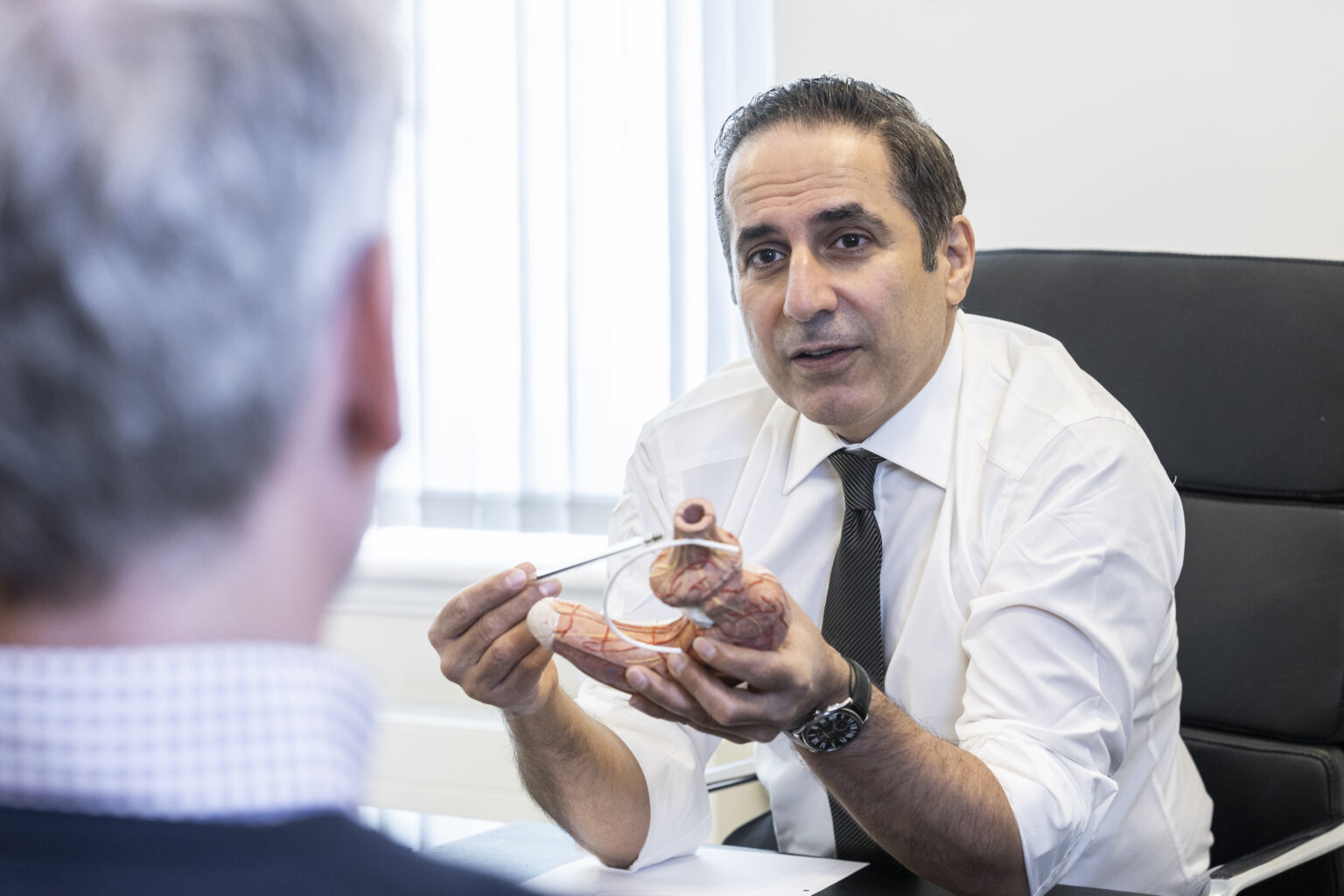
Laparoscopic fundoplication involves wrapping the upper part of the stomach (the fundus) around the lower end of the oesophagus and stitching it in place, creating a new valve mechanism that prevents stomach acid from rising into the food pipe. The procedure is performed using keyhole (laparoscopic) techniques through several small incisions in the abdomen, typically under general anaesthetic and taking one to two hours. Most patients stay in our hospital for one to two nights and can return to normal activities within two to three weeks.
There are different types of fundoplication, including Nissen’s (a full 360-degree wrap) and partial fundoplication variants such as the Toupet (posterior) and Dor (anterior) procedures. If a hiatus hernia is present, it is repaired during the same operation. Our GI surgeons will recommend the most appropriate technique based on your individual assessment. Based in St John’s Wood (NW8), we treat patients from across London.
Who is laparoscopic fundoplication suitable for?
Fundoplication may be recommended if you:
- Have been diagnosed with GORD, and symptoms have not responded adequately to proton pump inhibitors (PPIs) or other medications
- Prefer a long-term surgical solution over ongoing medication
- Have a hiatus hernia contributing to your reflux symptoms
- Have had investigations including endoscopy, pH monitoring or manometry confirming GORD
Your consultant will review your symptoms, test results and medical history to determine whether surgery is appropriate and which type of fundoplication is best suited to you.
How much does private Fundoplication for reflux cost?
from £7,150*
The cost of private fundoplication starts from £7,150* at St John & St Elizabeth Hospital.
*The price shown is an estimated guide to the hospital charges associated with your treatment from admission to discharge. Your final cost may vary depending on your individual clinical needs, the procedure performed, any additional treatments required, the type of implant/prosthesis used (where applicable), and the length of stay. This guide price excludes consultation fees, diagnostic tests, and professional fees charged separately by your surgeon, anaesthetist, and any other specialists involved in your care.
How to pay for your treatment
If you’re… paying for yourself
Did you know you don’t need private medical insurance to come to St John & St Elizabeth Hospital? As a self-pay patient, you can access safe, outstanding quality health care at times to suit you.
For scans and tests, as well as to see most consultants, you’ll still need to be referred by a medical professional like your GP, but as a self-pay patient, the process is more straightforward. You won’t need authorisation from an insurance provider, and you’ll have greater choice of consultant and appointment times.
If you’re… insured
St John & St Elizabeth Hospital is approved by all major medical insurance companies. If you have a personal private health insurance policy, or your company provide it for you, you can use it to pay for your care from your initial consultation through to treatment, surgery and aftercare such as physiotherapy.
Not all private health insurance plans cover the same things. It’s very important to check exactly what you are covered for with your insurance provider.
Frequently asked questions about fundoplication
St John & St Elizabeth Hospital is located in St John’s Wood (NW8), a well-connected and vibrant area of North West London, known for landmarks such as Regent’s Park and Abbey Road Studios. We are easily accessible from neighbouring areas, including Hampstead (NW3) and Kilburn (NW6):
- By Tube: St John’s Wood station (Jubilee Line) is just a 5-minute walk from the hospital. For patients travelling from Hampstead (NW3), Finchley Road station (Jubilee Line) offers a convenient route, while Kilburn (NW6) is similarly well served by the same line.
- By Bus:
Wellington Road: Routes 13, 46, and 113 stop near St John’s Wood Underground Station, just a short walk from the hospital.
Circus Road: Routes 46 and 187 stop close to the hospital’s Circus Road entrance.
Abbey Road: Routes 139 and 189 stop near the junction where Grove End Road becomes Abbey Road, providing easy access.
- By Car: If you’re travelling from NW3 or NW6, use major roads like Finchley Road or Kilburn High Road for a direct approach.
Our hospital’s location in St John’s Wood ensures easy access for patients across London, particularly from the NW8, NW3, and NW6 postcodes.
Gastro-oesophageal reflux disease (GORD) occurs when stomach acid repeatedly flows back into the oesophagus, causing heartburn, regurgitation, chest pain and sometimes a chronic cough or hoarseness. Most people are first treated with lifestyle changes and medication such as proton pump inhibitors (PPIs). Surgery is considered when symptoms persist despite medication, when a patient wishes to avoid long-term medication, or when a large hiatus hernia is present.
Laparoscopic fundoplication typically takes one to two hours under general anaesthetic. Most patients stay in hospital for one to two nights. You can expect some difficulty swallowing and bloating in the first few weeks as the swelling settles. Most people can return to desk-based work within two to three weeks and normal activities within four to six weeks. Your diet will need to be modified initially, starting with soft foods before returning to a normal diet over time.
Private laparoscopic fundoplication at St John & St Elizabeth Hospital starts from £7,150*. The final cost depends on your individual clinical needs and the type of procedure performed. Please see the pricing section above for full details, or contact us to discuss your options.
Yes there are alternative treatments to fundoplication.
Non-surgical alternative treatments to fundoplication include medication such as PPIs or diet changes.
Surgical alternative treatments to fundoplication include treatments such as LINX or RefluxStop, both of which are available at St John & St Elizabeth Hospital.
Medically reviewed by Mr Majid Hashemi - MB ChB FRCS (Gen) on 30/11/2024